What Dom's Games Look Like
Blogwagonning off similar posts by Grace, Louis and Phlox, I thought I'd describe how I run and prep games.
Running Games
All of my games are run virtually over Discord and various online tools at this point. The dread Scheduling Beast came for the hobby time of my players and I shortly before Covid and we regrettably never returned to meeting physically. We always use voice and sometimes throw gifs, links or short quotes in chat to accentuate our conversation, but never use webcams. Conversation naturally drifts between speaking in character and discussions out of character as the session progresses, with the default usually being out of character voices.
Character sheets are documents kept by the players on their machines (or physically). I have players roll dice on their end, either physically if they have them or using an online roller / another player rolling for them if not. I don't bother checking the veracity of either unless I hear a number far out of the ordinary, though rules questions about modifiers come up often enough that if somebody does accidentally have an error they have ample opportunity to fix it. I figure if someone is purposefully cheating their other behavior and shame will give them away, I've never had a problem with it with any of my long term players. We use shared documents for anything that multiple players will need to interact with, like shared inventories / storage or lists of faction assets.
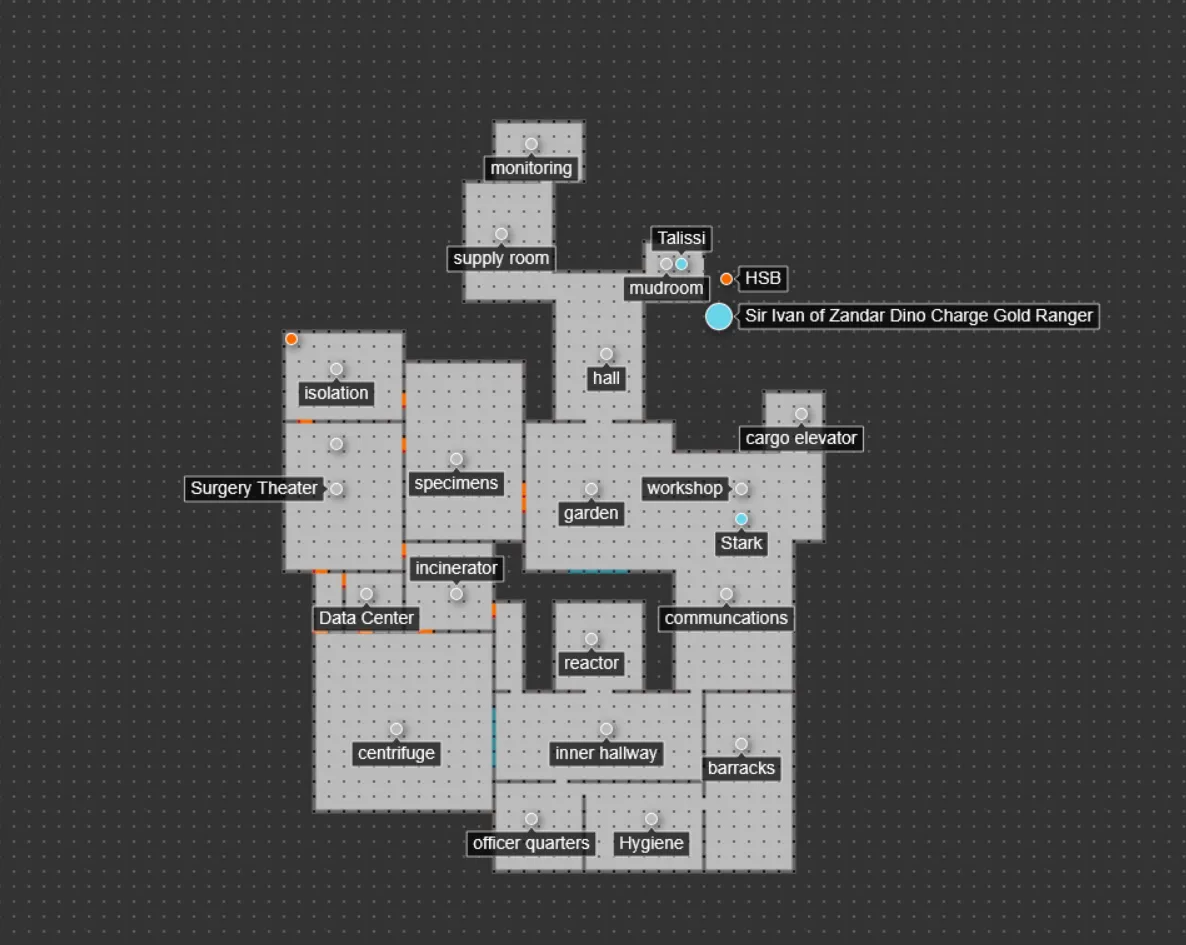
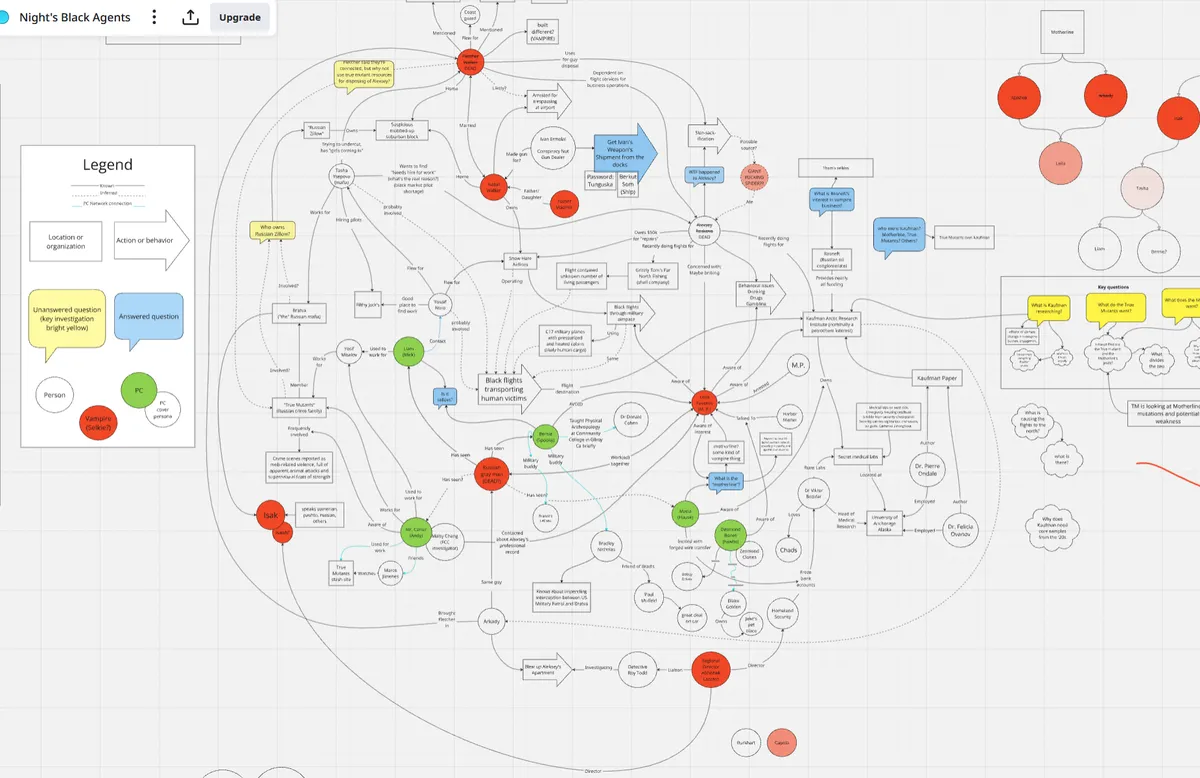
I use Shmeppy to represent battle maps for conflicts for D&D/OSR likes and Miro for collaborative clues/leads for investigative games. Shmeppy is a simple grid tool that most accurately emulates the classic Chessex Battlemap that I cut my teeth GMing on, I'm quite fond of it. Miro could easily be replaced by any other collaborative flowchart tool, I'm not really very happy with it but it's been useful in the past. I don't bother to use a visual reference for most D&D-like sessions (really only breaking it out for battles or in-depth dungeon crawling), but I extensively use a leads/clues tracking tool while running investigative games so everyone can keep track of what's happening.
Shmeppy example map:
Miro example mindmap:
For the most part, I run a session as long as I have at least 3 players committed to showing up for that session. Anything less than 3 players and there's not enough friction for the session to be interesting -AND- players often feel like they can't make good headway on any of their goals. Cancelling at the last minute is not uncommon when schedules clash, but I try to avoid it when possible.
I take my session notes in a physical notebook and some of the players take their own notes, typically of NPC names and motivations. We have back-and-forth discussions when notes clash or we don't recall exactly where we revealed a specific piece of context or made a decision, I'm famous for forgetting the name (but never the context and motivations!) of minor NPCs. If we can't come to mutual agreement, I make a new ruling and canon is retroactively changed to fit, with much notetaking on both sides confirming the new value.
Dice rolls and system interactions come up whenever we can't move forward just discussing plans made and actions taken. We all cross-check the rules together quickly, even if I'm the one who wrote the system. Much like disagreements about canon, I make a ruling on the spot if we can't come to quick mutual agreement and we take note of it for the future. Past litigated rulings are often revisited as context and temperaments change. If players are stagnating and not acting or productively planning for long periods (30+ minutes), I prod them and get them to change their conversation tack until we start flowing again.
I don't mind if people get up and leave mid-session to go to the bathroom or grab food or what have you, so long as they're quick about coming back. I do get pretty irritated when it's obvious someone is playing a video game or watching something else on their other monitor, it's insulting and disrespectful enough that I've cancelled whole games (not sessions) over it. Conversation is otherwise very freeform and I mostly leave it up to the players, I will call on specific folks to chime in if they've been quiet for a while.
Prepping Games
My prep is largely fueled by spurts of motivation and looming deadlines. I'd describe it as the messy pigsty version of Jack, from Grace's post, I like to pick a cool scenario / idea / location / concept / pun like "corpo penthouse suite" or "dragon that only respects master fishermen" or "cursed spellbook that traps you in the crystal for 20 years" and prep backwards from my cool concept until I run into wherever I last left my players. As I move backwards, I write down semi-related obstacles, NPCs, monsters and magic items etc in my notebook. If I've found any cool new RPG theory blogpost about a new subsystem or new way to prep, I throw them in hodgepodge with all the rest of my notes. Same with any cool magic items or monsters I read about from the blogosphere, chewed and massaged slightly to fit the setting I'm running.
The only consistent pieces I bother to write down are the pieces that I have trouble improvising: precise facility map layouts, statblocks, random tables, lists of names. Obstacles and unforeseen complications I find pretty easy to improvise, same with mechanical text for magic items and spells (though I do write down cool names for items and spells). NPC context and motivations are also easy for me to improvise so I don't usually bother writing that down, but I do forget names and so I keep track of those. The nature of what I end up writing down is that it's all pretty reusable, so I don't feel too bad about skipping over something I prepped if I don't think it will fly well in that night's session.
I start prepping for a game or session whenever I don't really have an idea of what's going to happen next. Sometimes the prep I write lasts for a single session, more often it lasts for a couple sessions. I'm not afraid to abandon the original "cool idea" in a heartbeat if the party ends up taking us on a different path, but I do need to think up a new one to spark more prepwork.
Whenever I run modules, the only real change to the above process is that I find my cool idea within the module. Sometimes I need to change or tweak the module to accomplish this and end up entirely derailing, but I view this as a feature and not a bug.
Conclusion
How do you prep and run games? Do you find it easy and fun to prep or complex and stressful? How about running games, do you find it relaxing or taxing?